Copyright 2009-2014 by Holly K. Austin unless otherwise noted. All rights reserved.
PLEASE DO NOT COPY OR USE ANY IMAGES FROM THIS SITE WITHOUT PERMISSION!
If you would like to use an image for some purpose, please contact me via the comments feature.

Really Stinkin' Old.

>> Thursday, August 14, 2014

Much of the reason I wanted to go to Israel so badly is its ancient history.  I love Biblical history and archaeology.  Though I am not in any way religious, I was raised Catholic so grew up knowing the Bible stories.  I love archaeology, so adore the use of modern technology to clarify, confirm, or refute ancient stories.

Mostly I just plain love OLD things.  Really really old.  And that Jerusalem has in abundance.  These photos are a few of the old things that captured my eye or imagination or both.

Stairway for climbing onto the ramparts at the Jaffa Gate:


Station 8 of the Cross, on the Via Dolorosa. Station 8 is across the market street and up the steps of Aqabat al-Khanqah, opposite the Station VIII Souvenir Bazaar. (Yes, plenty of stores cater to tourists while oozing cheeze.)  The stone bears a cross and the Greek inscription "NIKA," and is on the wall of the Greek Orthodox Monastery of St. Charalambos.  Station 8 supposedly marks the place where Jesus consoled the lamenting women of Jerusalem (Lk 23:27-31), though modern archaeology does not necessarily support that the Via Dolorosa is actually the route Jesus would have walked.

A random old door.  I wonder how many coats of paint it has on it?


This is the door to the Church of the Holy Sepulchre.  I LOVE the old inscriptions, and wondered many times while in Jerusalem exactly what the dividing line is between "graffiti" and "wicked cool historic markings." A side note, there are six Christian sects (Greek Orthodox, Armenian Apostolic, Roman Catholic, Coptic Orthodox, Ethiopian Orthodox, and Syriac Orthodox) that share the Church of the Holy Sepulchre, and they can't get along, each arguing their claim is more significant, or that another sect is interfering with their rites, etc.  Yes, monks have been known to throw punches in the church in recent times - there was a brawl as recently as 2008.  Since the Christian sects can't agree who among them should hold the keys, since 1192, a pair of Muslim families has kept the keys to the Church, and open it and close it every day.

These are graffiti from the time of the Crusades.  Allegedly you can tell from the styles of the crosses which particular sect the carvers belonged to.


Ancient ossuaries on the Mount of Olives on the grounds of the Dominus Flevit Church.  Jewish law requires that people be buried within 24 hours of death.  Stone ossuaries like these would be used for secondary burial (burial of just the bones) during the Second Temple period and they were very common from the second century BCE until the first century CE. 

These ossuaries are decorated with typical symbols, among them the lily flower, the six-petal rosette.  Of course, the small one would have been for a child.


This is also on the grounds of the Dominus Flevit Church.  It's a Byzantine mosaic, impeccably preserved and absolutely lovely.  I love how they made the ribbon around the edges look three dimensional.


This is the "Golden Gate," in the middle of the Eastern Wall of the Temple Mount. The Dome of the Rock is seen peeking over the side of the wall on the left.

The Kidron Valley astonished me in how Biblical it LOOKS.  Much of the area around the Old City has been developed into modern facilities, but this area has remained undeveloped.  If you look down to the left in the Valley, you see the pointy top of what is called the "Tomb of Absalom." Although traditionally ascribed to Absalom, the rebellious son of King David (circa 1000 BCE), recent scholarship has attributed it to the 1st century CE.


The tombs of Zachariah and Bnei Hezir, in the Kidron Valley. The one in the foreground, which is the tomb of Bnei Hezir, is dated to the beginning of the 1st Century BCE, during the Hasmonean period.  They are entirely carved from the surrounding rock, not constructed.


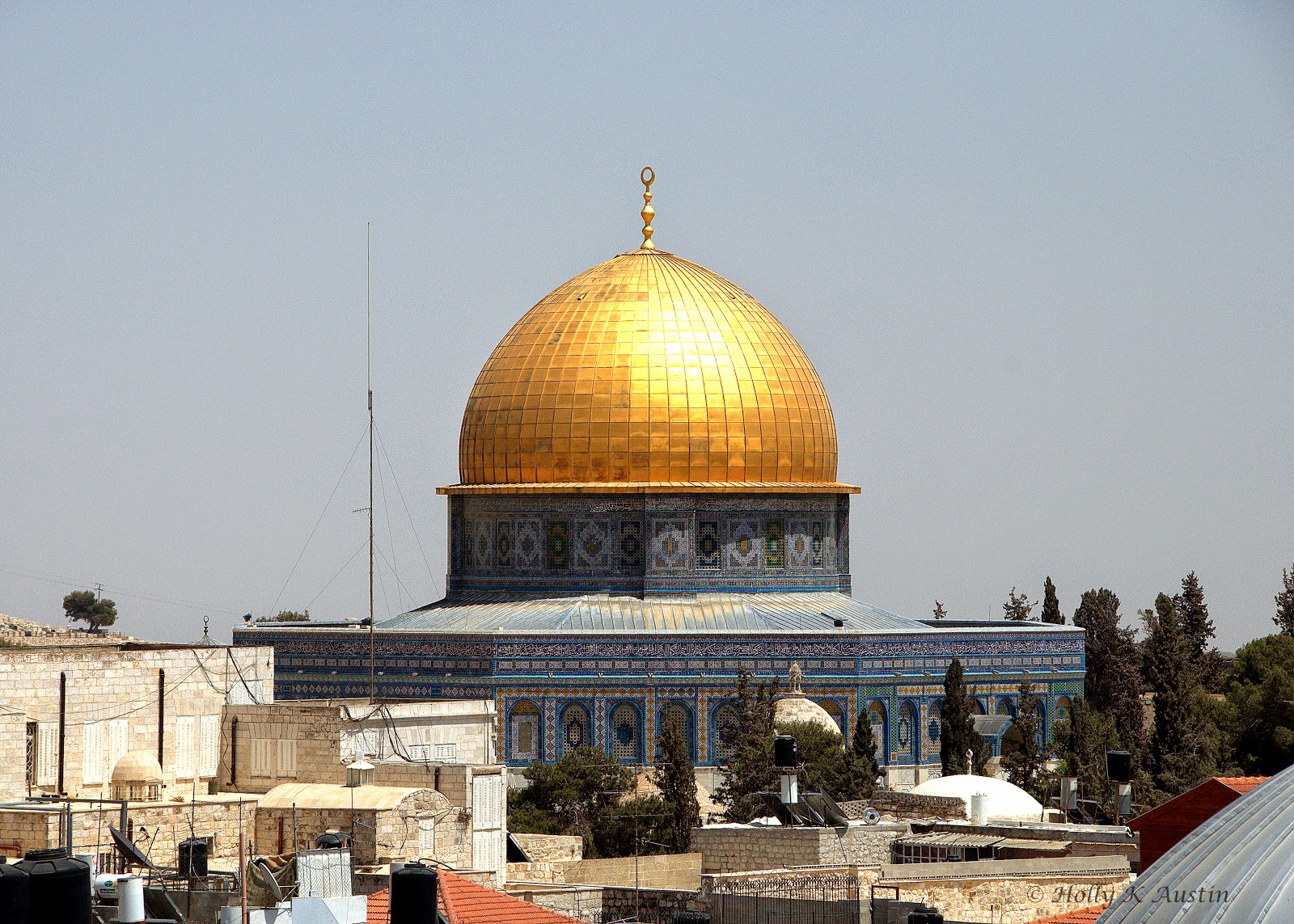
Of course, the Dome of the Rock itself is very old, having been constructed around 691 CE.  During the entire time I was there, non-Muslims were not permitted to go up to the platform, but whether that was because it was Ramadan or because it was a time of political unrest, I do not know.  Maybe both.  Maybe next time I go I will be able to get closer.


This is an archaeological dig just outside the Ancient City of David.  It used to be a parking lot.  Most of the finds at this site have been Roman or Byzantine.


And THIS is one of the spots I was most excited to visit while in Jerusalem.  The photos aren't impressive or artistic, but the experience was beyond remarkable.  It is the entrance to Hezekiah's Tunnel, which was dug as an aqueduct from the Gihon Spring to the Pool of Siloam. According to legend, King Hezekiah prepared Jerusalem for battle with the Assyrians by blocking to source of the waters of the upper Gihon (2 Kings 20:20). The Tunnel has actually variously been dated by experts from any time between late 9th Century to early 7th Century BCE. The tunnel is 533 meters long, and according to an inscription, was excavated by two teams, one digging from each end.  The original plaque marking where the two teams met is now in the Istanbul Archeological Museum, having been removed at some point during Jerusalem's long period of Ottoman rule.

I've read about Hezekiah's Tunnel, which had been lost to history and rediscovered in the 1830s, and always been amazed by it.  Clearly I'm not the only person enchanted with it, since it appears in various works of literature.  Can you even fathom digging a tunnel through solid rocks with hammers and chisels, and having the two teams ACTUALLY meet in the middle?  They weren't just digging in a straight line, either.  The tunnel twists and turns.


Remarkably, you can walk through it.  The water level is now somewhat controlled, though up until quite recently a sudden rain storm during the rainy season could fill the tunnel rapidly to its ceiling, drowning anyone who was in it.


It was pitch black except for our tiny flashlights, full of cool sweet water (remember it was about 98 degrees and blazing sun outside).  There were places where the ceiling was so low I had to bend over, and the tunnel was for most of its length darn close to the width of my body.  It was a tight squeeze.  My whole family happily splashed our way through its narrow winding 533 meters, including my 9 year old niece.  Being seriously claustrophobic, the trip required two klonopin for me to manage, but it was definitely one of the highlights of my trip - hell, it was one of the highlights of my life so far.

It emerges into the Pool of Siloam.  For many years they thought this was the extent of the legendary pool, though a recent sewer pipe rupture led to excavations that uncovered a much larger pool a few feet away.


St. Helen's Coptic Church, in a cave/cistern supposedly discovered in the 4th Century by Constantine's mother Queen Helena.  This is part of the Church of the Holy Sepulchre.


Obviously the signs aren't old, but so many of the streets within the walls of Old City of Jerusalem just feel ancient.


Another spot I was very excited to visit.  This is variously known as Zedekiah's Cave, Solomon's Quarries, Zedekiah's Grotto, Suleiman's Cave, the Royal Caverns, Royal Caves, Royal Quarries, Korah's Cave, and the Cotton Grotto.  Take your pick!

The photo is pretty awful - my camera does not do well in low light, and this was just taken with my iPhone's panoramic feature.  These caves are entered through a door in the walls of the City, between the Damascus and Herod Gates.  These caves extend waaaaaay under the City.  The part that is accessible to visitors certainly does not include the entirety of the caves.  Laurie R. King wrote about these caves in her book O Jerusalem, and the main characters end up under the Dome of the Rock, starting from these caves.  I can imagine it just might be possible.  I recommend the book, by the way.


The gardens around St. Anne's Church contained all sorts of amazing bits of stones and carvings, in addition to the ruins of a Byzantine church and Roman temple to the god of medicine.  These rest of the photos are from the ruins and gardens.


Read more...

Israel 2014

>> Wednesday, August 13, 2014

I had the astounding privilege of visiting Israel this summer.  My sister and brother-in-law had planned a trip, and they allowed my mother and me to tag along because they had extra beds in the apartment they rented in Jerusalem. I've wanted to go to Israel for as long as I can remember, and leaped at the chance.


Before I post all the photos though, I thought they needed a little context in light of the ugliness of the last few months for both Israelis and Palestinians.

Thankfully, we timed our trip just right.  Before we left, I anxiously listened to the NPR piece announcing that Fatah and Hamas had reconciled, and a unity Palestinian government had been formed.  Then, the three Israeli teens, Eyal Yifrach, Naftali Frankel and Gilad Shaar, were captured in the West Bank.  They had already been killed, but most of Israel and the rest of the world did not yet know that. Israel is a small country, and at the time I arrived at Ben Gurion airport in Tel Aviv, many, many people were gathering all over Israel and fervently praying for their safe return. Their bodies were found while we were there. It was also while we were there, toward the end of our stay, that Palestinian teen Mohammed Abu Khdeir was captured and brutally murdered, and rioting began in East Jerusalem.  We left just a few days before huge volumes of rockets started to be exchanged between Israel and Hamas.

Though all this upheaval was ramping up during our stay, life inside the walls of the Old City of Jerusalem just carried on.  There was only one day that was tense inside the walls while I was there, and it was the day when Mohammed Abu Khdeir had been so brutally murdered, but no one had yet been arrested.  Everyone seemed tense, and certain parts of the Old City of Jerusalem did not feel safe for me that day, despite the many, many armed police and military flooding inside the walls and standing guard.  Aside from that one day, though, I felt warmly welcomed in Israel, by people of all faiths.


The trip was spectacular, despite the political background.  It was once I returned and watched the region I had fallen in love with erupt (again) in devastating bloodshed, that the real meaning of the conflict hit me.  I was stuck relying on news reports that, at least on U.S. web sites, was woefully inadequate and delayed. After significant effort, I finally found some more reliable sources of information from mid-east media web sites, Twitter feeds from people who were actively trying to negotiate a cease fire, or who live in various places (including both Jerusalem and Gaza), and some good Facebook pages to follow.  But until I found those sources of real-time unfiltered information, I experienced this ongoing writhing horror that the places I had just been and loved could have been damaged or even obliterated by rockets, and I wouldn't yet know it.  Of course, much of Gaza WAS obliterated, but at least the ancient sites I so loved in Jerusalem remained largely unscathed.  Not that that is any comfort for any of the people of Gaza.

As things (temporarily?  for how long?) are a little quieter in Israel and Gaza*, I have a tremendous number of thoughts about the region, the politics, the people, and how bleak the future looks for any kind of real and lasting peace.  It doesn't help that Syria and Iraq are being gobbled up by the extremist Islamic State (formerly ISIS), with people in all the surrounding countries fearing its continued expansion. The Middle East has been volatile essentially for all of recorded history, and looks to remain so for the foreseeable future.  It's heart breaking, for so many reasons.

But the Old City of Jerusalem?  Oh, how I love it!  I'll post photos in several different posts, because there are too many to absorb at once.  Most will be of Jerusalem, but we did take one day trip to Qumran, Masada, and the Dead Sea as well.  (And yes, I am aware merely visiting those sites is political, given that they are in the West Bank. *sigh*)

And now, with no further political reflection, Jerusalem, as I saw it in June and July 2014.  First?  The people:

This was the view from my bedroom balcony in our apartment.  It's in the Jewish Quarter, very close to the Western Wall.  I love this square, that had cafes and birds, scrounging stray cats and buskers, and so very many people always walking through on their way to or from praying at the Western Wall.


Scenes from walking the streets and markets:


There were many Pilgrims, of course.  This is at the Church of the Holy Sepulchre.  The stone around which people have gathered is the Stone of the Unction, or Stone of the Anointing, on which Christ's body is said to have been laid and anointed after his crucifixion. However, whether it was really used for that is questionable, since this stone was allegedly first mentioned by the pilgrim Riccoldo da Monte Croce in 1288. Many people rub objects on the stone, seen here, believing it makes them holy.


The Western Wall.  My favorite spot in all of Israel.  A place of peace, comfort, beauty, community, and of course, prayer.


Though sadly it must always be guarded.


 A scribe working at Masada:


Bedouins in the Judean Desert, making a living by giving tourists rides on a camel.


My niece and I were some of those tourists.  I love that the camel is smiling in this picture:


And my family, walking the ramparts:


More posts to follow.

* Not an hour after I posted this, I'm starting to see information that there have been some new red alerts in southern Israel, as the current cease fire window draws to a close. Hoping it's not Hamas rockets, hoping this is not starting all over again, hoping the cease fire will miraculously be extended by both sides.  Hoping sometimes seems so darn futile.

Read more...

Three Jobs

>> Wednesday, April 23, 2014

I've been badly neglecting this blog lately, though I would argue for good reasons.  My life has been absurdly full, but in excellent ways.

I still, of course, have my career as an environmental attorney.

As of January, I have also been honored to be the President of the Board of the Matilda Joslyn Gage Foundation (I had served on the Board for a few years prior to becoming President).  It's an amazing not-for-profit organization, whose mission I believe in heart and soul: "The Matilda Joslyn Gage Foundation is dedicated to educating current and future generations about Gage’s work and its power to drive contemporary social change."  Matilda Joslyn Gage was a suffragist, abolitionist, a progressive human rights visionary, and a passionate activist.  The issues that motivated Gage's life and career are still of fundamental importance today, and being able to help continue her work is deeply satisfying and of utmost importance.

2014 has been a very busy time for the Gage Foundation, as we have been going through a reorganization process to address succession planning, financial planning, and strategic planning. It's involved very long hours by quite a number of dedicated people, but it's all worth it. I am so excited about the future of the organization.

In addition to all THAT hard work, I have also still been a hard-working artist.  It feels at times like I'm juggling three full jobs.  Art, though, feeds my soul, and in some ways gives me the energy to do everything else I do.

I have a new art website up, finally, at http://www.hollykaustin.com/.  Please surf on over!  I also have an upcoming art show, together with my legal colleague Doreen A. Simmons, Esq., during the month of May, at bc Restaurant at 247 W. Fayette Street, in downtown Syracuse.  If you're in the Syracuse area, please hop on over to bc during the month of May for a fantastic meal and some artwork!

Read more...

  © Blogger templates Shiny by Ourblogtemplates.com 2008

Back to TOP